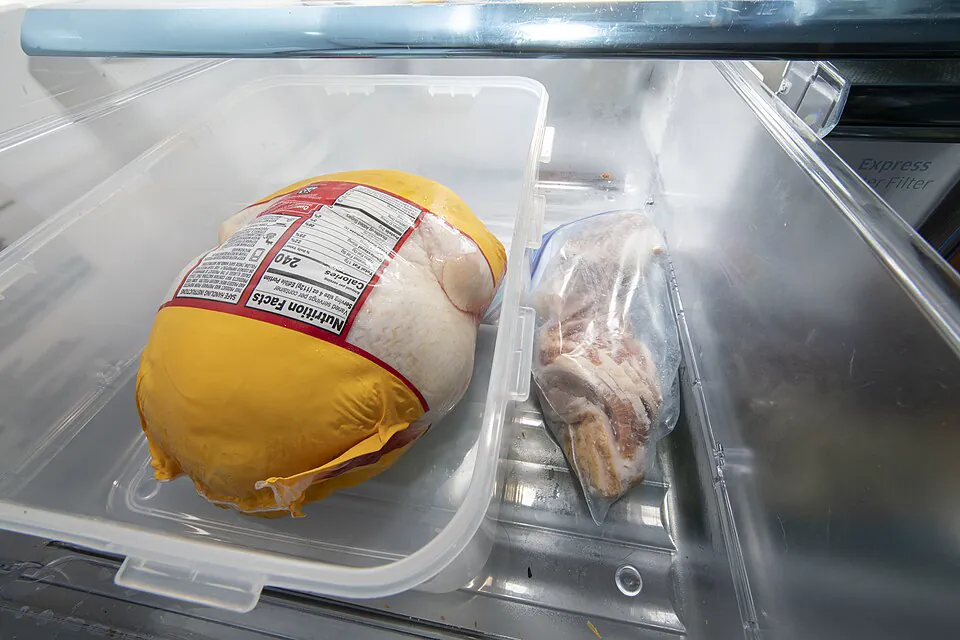
Freeze meat in the quantity one future meal needs, use packaging intended for freezer storage, remove avoidable air without crushing the food, and label cut, weight or portions, and freeze date. A strong package still needs a rotation system.
Choose the future meal before sealing
One oversized freezer package creates an all-or-nothing thaw. Divide sale packs and bulk orders into the number of portions your household normally cooks at once, then keep one intentionally larger batch pack only when the calendar supports it.
Match packaging to storage horizon
Original retail wrap may be convenient for a short plan, while longer storage can benefit from an additional freezer-rated barrier or vacuum packaging used according to its instructions. Packaging helps quality; it does not make unsafe handling safe forever.
Label decisions, not just nouns
Write the cut/product, weight or portion count, freeze date, and—when useful—the planned meal or method. “Beef” does not help a busy cook choose between a quick sear and a long braise.
Freeze flat or in useful shapes
Flat ground-meat packs and single-layer portions can stack and thaw predictably. Protect bones and sharp edges from puncturing the wrap, and avoid shapes that block baskets or hide labels.
Build retrieval into capacity
Do not plan to fill every cubic inch. Use zones, baskets, or a simple inventory, move older packages forward, and keep room to handle and count inventory.
| Decision | Write or do | Failure prevented |
|---|---|---|
| Meal size | Portions per package | Thawing too much |
| Identity | Cut/product and protein | Mystery packages |
| Quantity | Weight or serving count | Underbuying the rest of the meal |
| Time | Freeze date | Poor rotation |
| Purpose | Method or planned meal when helpful | Thawing a cut that does not fit the schedule |
Cold-storage temperature boundaries
USDA FSIS Freezing and Food Safety and Refrigeration and Food Safety factsheets (linked in Next decisions and planning methodology); accessed 2026-08-24.
| Storage zone | Official target | Outside the planner model |
|---|---|---|
| Freezer | 0 °F (−18 °C) or below | Not inferred from yield formulas |
| Refrigerator | 40 °F (4 °C) or below | Short-term holding; check with appliance thermometer |
| Counter thaw | Not recommended | Use an official thaw method instead |
Worked example
Portion a family pack into decisions
The planner estimates 12 cooked servings from a package and the household uses four servings per dinner. Make three meal packs, not one 12-serving block. If one meal is a batch recipe for six, create one six-serving pack and two three-serving packs only if three servings match a real lunch or smaller-household use.
Label each package with identity, raw pack weight, freeze date, and intended method. Update the freezer inventory at the same time; packaging without retrieval is incomplete.
Planning ranges are editable assumptions, not universal yields or safety tests. Follow the package and current official guidance. Audit the planning method and sources · return to the planning hub.